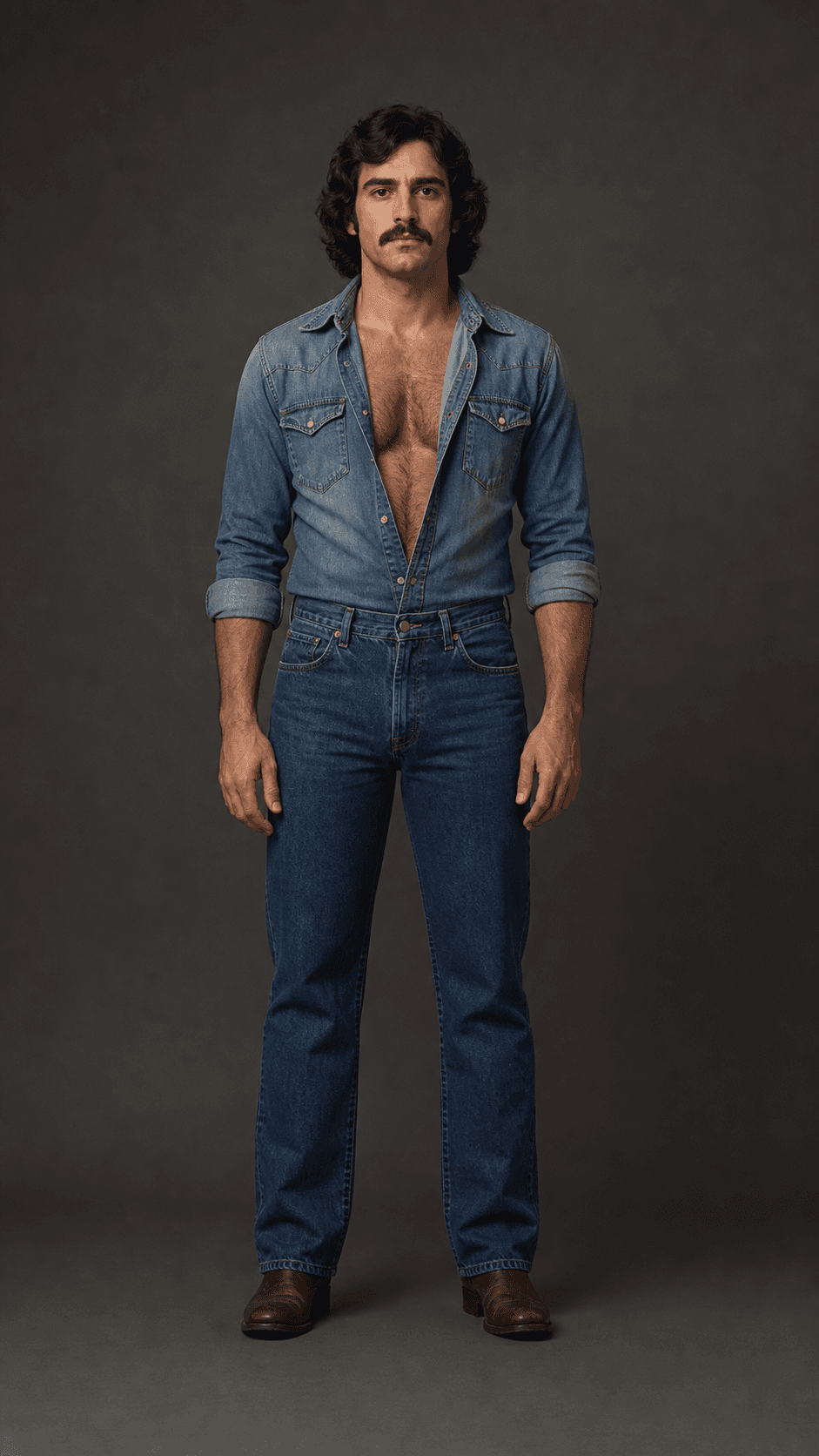




Almost everyone now shares the same gym locker room: the macho, the yuppie checking notifications between sets, the metrosexual with his wash bag, the gym bro and the boy with a pearl necklace and swimmer’s shoulders. Fifty years of masculinity did not follow one another. They piled up in the same changing room.
The biological mystery
Stories about the end of the Western man always arrive fully dressed: soft jawline, civilisation in collapse. The data, less elegantly, end up arguing among themselves.
In 2025, a meta-regression brought together 1,256 papers, 1,504 study groups and 1,064,891 participants. More recent papers reported lower average levels even after the available adjustments for sample size, age, body mass index and method. This is not, however, a film shot with the same men over fifty years. The figures are aggregated and exposed to differences in selection, sampling and laboratory practice.
When the authors narrow the field to measurements made by mass spectrometry, the decline is not confirmed; only five of the 117 papers in that subgroup predate 2000. A comparison of two large US National Health and Nutrition Examination Survey cycles likewise finds no significant difference in total or free testosterone after adjustment. Obesity, medication, sleep and the environment remain plausible hypotheses, not a single explanation already proved.
A meta-regression of aggregated data; the trend remains after the available adjustments for sample size, age, BMI and method.
You cannot see testosterone
Testosterone enjoys a rare privilege: everyone believes they can recognise it. In a beard, a pair of shoulders, the way someone sits with his knees too far apart; even in the choice of a shirt. A photograph, unfortunately, shows muscle, clothes, pose and a variable amount of vanity. Genetics, age and development do the rest; for aggression, the average association found by studies is very small and depends on context.


A photograph shows muscle, clothes and pose. It does not return a hormone value.
The Endocrine Society and the American Urological Association require compatible symptoms or signs, two morning samples with persistently low values, and then a search for the cause. Total testosterone, free testosterone and sex hormone-binding globulin require different readings. It is less photogenic work than a motivational reel, but it has the advantage of being medicine.
That is why Jordan-Young and Karkazis appear here as scholars of scientific language and the hormone’s cultural history, not as clinical authorities. Carole Hooven supplies the evolutionary counterpoint; for physiology, diagnosis and treatment, this article relies on primary studies, clinical guidelines and the reference book edited by endocrinologists Eberhard Nieschlag and Hermann Behre.
Fifty years of men, all in the same present
Every era claims to have invented a new man and immediately buys him a jacket. Martin P. Levine places gay macho in the 1970s; Susan Jeffords read the “hard body” of Reagan-era cinema as a political body before it was a workout plan. The yuppie adds class, consumption and a tie expensive enough to look restrained. In 1994, Mark Simpson coins “metrosexual”; in the 2000s, the male bathroom finally acquires more than one shelf.
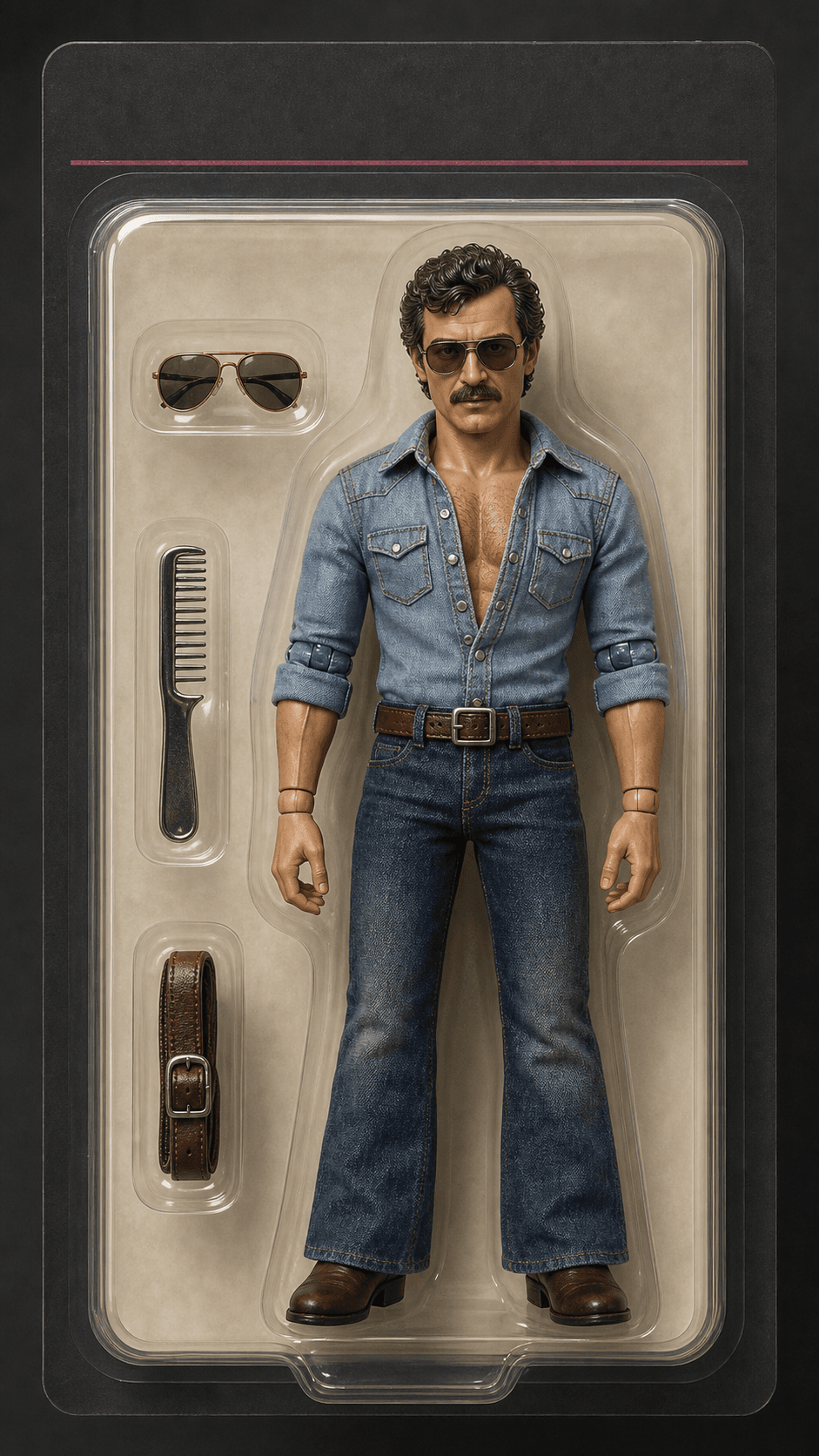

move the cursor · drag on touch
The macho does not disappear when the yuppie arrives.
In our casting, Burt Reynolds, Michael Douglas, David Beckham, Dwayne Johnson and Timothée Chalamet are iconographic shorthand. We use the public face they lent to an era and leave their medical records out of the article. Gym bro, twink and soft boy come from different genealogies, across physical culture, queer subcultures and internet aesthetics; the twink and South Korean soft masculinity have distinct histories, even if a dim algorithm might place them in the same folder. There is no evidence of a causal link between the spread of these repertoires and hormone levels. By the time the laboratory delivers its results, the wardrobe has already changed season.
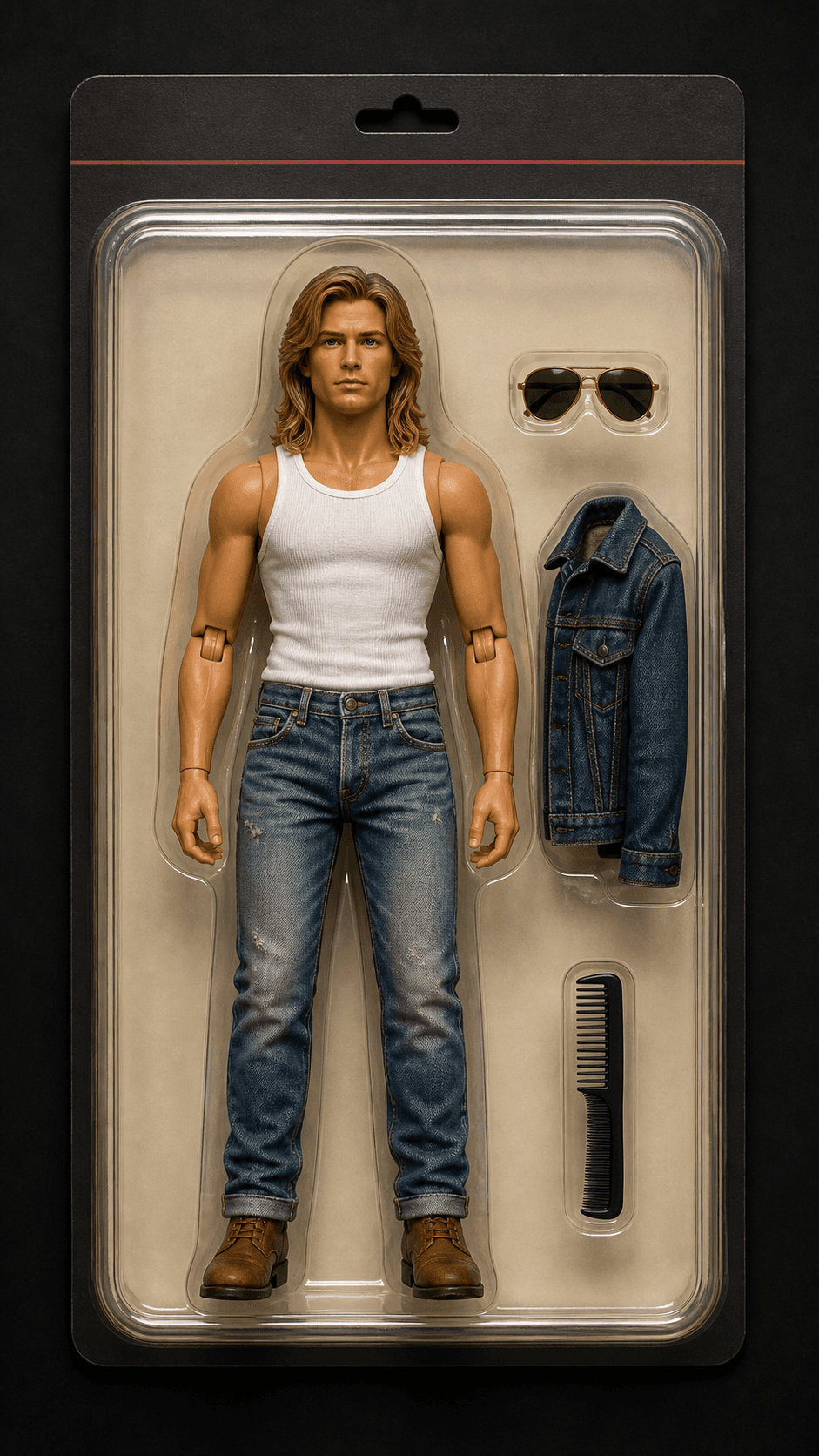
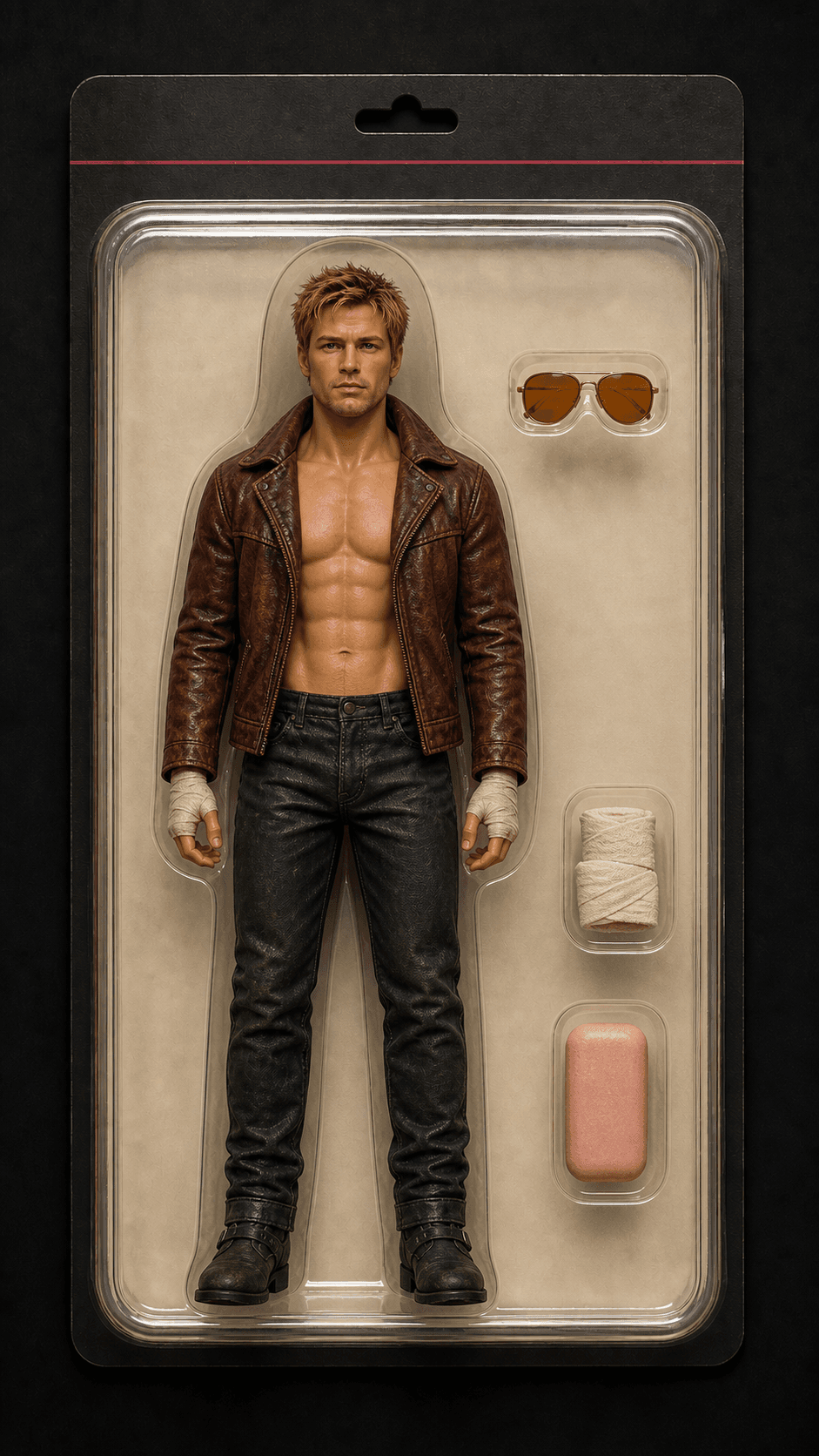


four men
1991 · Pretty boy. Cinema offers him to the gaze before it offers him to the action.
When testosterone becomes an answer
Every anxiety widespread enough eventually finds someone willing to put it on subscription. The commercial “Low T” frame takes fatigue, desire, age and performance, arranges them under the same bathroom light, and offers sex, muscle, energy and rank. In a 2022 audit, six of seven direct-to-consumer platforms offered testosterone to an undercover 34-year-old customer with normal levels who wanted to preserve his fertility. It is a small sample, so it documents a practice, not its prevalence. Meanwhile, the page had already asked for his card details.
Fitness marketing sells performance and muscle; the manosphere uses the hormone as a ranking system; supplements promise to raise it, although a review of 27 substances or formulations found that most do not reliably increase total testosterone. Replacement therapy for selected patients belongs to the clinic. The booster with a lightning bolt on the bottle belongs to the aisle where male insecurity meets graphic design.
A qualitative analysis published in 2026 of Instagram and TikTok content from testosterone platforms identified four recurring frames: a crisis of masculinity, younger men and fitness, self-optimisation, and the opposition between the “real” man and femininity. It describes the messages in circulation; it does not measure how many people believe them.
Jordan-Young and Karkazis reconstruct the history that turns testosterone into the scalable essence of masculinity. Hooven offers a different, evolutionary account. The disagreement is not about whether the hormone exists, but about how many human things it can be made to explain.
In February 2025, the US Food and Drug Administration announced class-wide labelling changes: the reference to major cardiovascular events came out of the boxed warning, its most serious warning, while information on blood pressure went in. In June 2026, the agency asked manufacturers to remove the age-related limitation of use and update information on the prostate and benign prostatic hyperplasia. On its current information page, however, it still distinguishes products approved for men whose low testosterone is associated with a medical condition from use in men without an associated condition. The regulatory picture has changed; it has not become a licence for optimisation.
The possible decline in average testosterone and the transformation of masculinities come from different archives. The Low T market puts them on the same page: more testosterone, more man. The appointment is booked online; the order-confirmation email follows shortly afterwards.
↓ sources and further reading
- Santi et al., “Temporal trends in serum testosterone and luteinizing hormone levels…”, 2025. ↗
- Nyante et al., “Trends in sex hormone concentrations in U.S. males”, 2012. ↗
- Andersson et al., “Secular decline in male testosterone and SHBG serum levels…”, 2007. ↗
- Bhasin et al., Endocrine Society Clinical Practice Guideline, 2018. ↗
- Mulhall et al., AUA Guideline, 2018. ↗
- Geniole et al., “Is testosterone linked to human aggression?”, 2020. ↗
- Rebecca M. Jordan-Young and Katrina Karkazis, Testosterone: An Unauthorized Biography, 2019 — science studies, with an explicitly critical perspective. ↗
- Carole Hooven, T: The Story of Testosterone, the Hormone That Dominates and Divides Us, 2021 — evolutionary biology, read as a counterpoint. ↗
- Eberhard Nieschlag and Hermann M. Behre, eds., Testosterone: Action, Deficiency, Substitution, fourth edition, 2012 — a clinical reference work. ↗
- Connell and Messerschmidt, “Hegemonic Masculinity: Rethinking the Concept”, 2005. ↗
- Susan Jeffords, Hard Bodies, 1993. ↗
- Martin P. Levine, Gay Macho, 1998. ↗
- Mark Simpson, “Here Come the Mirror Men”, 1994. ↗
- John Mercer and Clarissa Smith, Sexualised Masculinity: Men’s Bodies in 21st Century Media Culture, 2025. ↗
- Sun Jung, Korean Masculinities and Transcultural Consumption, 2011. ↗
- Richard Vytniorgu, “Twinks, Fairies, and Queens”, 2023. ↗
- Dubin et al., “Guideline-Discordant Care Among Direct-to-Consumer Testosterone Therapy Platforms”, 2022. ↗
- Gram et al., “Selling Masculinity”, 2026. ↗
- Debbie Ging, “Alphas, Betas, and Incels”, 2019. ↗
- Morgado et al., “Do testosterone boosters really increase serum total testosterone?”, 2024. ↗
- Lincoff et al., “Cardiovascular Safety of Testosterone-Replacement Therapy”, 2023. ↗
- FDA, class-wide labelling changes, 28 February 2025. ↗
- FDA, “Testosterone Information”, updated 18 June 2026. ↗
Editorial method: the data scenes summarise the conclusions and limits of the cited studies. The actors are iconographic shorthand, not clinical cases; the article attributes no hormone levels to them.
↓ image credits for the casting
- Burt Reynolds, Alan Light, CC BY 2.0.
- Michael Douglas, Gerhard Heeke, CC BY-SA 3.0.
- David Beckham, Christophe95, CC BY-SA 3.0.
- Dwayne Johnson, David Shankbone, CC BY 3.0.
- Timothée Chalamet, Amy Martin Photography, CC BY 4.0.
Images cropped, converted to black and white and assembled by KANSEI. The composite is distributed under CC BY-SA 4.0.