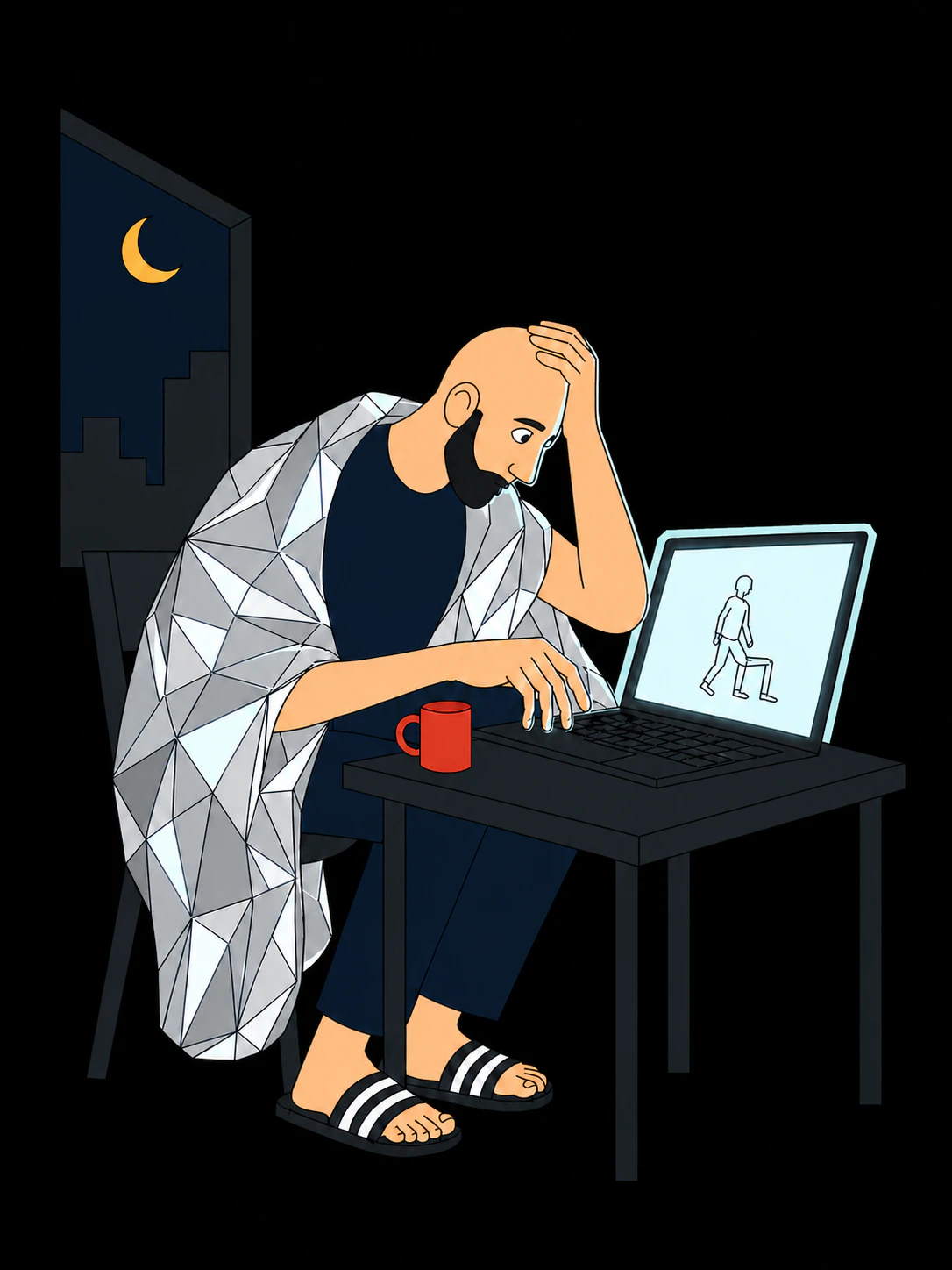
I haven't slept in days, I've been living for weeks locked in a room, in the dark: partly because it's 36 degrees perceived even at night, partly because I can't bring myself to abandon my project. I can't remember the last time I ate or spoke to another person, and now I'm starting to talk in strange ways: I say deploy, I say push, I say let's commit. I've become someone who thinks they're working with artificial intelligence. Instead, I'm working for artificial intelligence.
Let me take you back to when Federico Bottino asked me to write for his newspaper. I said yes. Then he told me: «But there is no newspaper — you have to build it. Good luck!». And he vanished. Before all this, I used ChatGPT on the sly at the office, constantly asking it to fact-check the nonsense I was reading. It's a bit like Google Maps, which destroyed what little sense of direction I already didn't have, or Google itself, which has made me lazy: I type «actress lgtpa ngodo n» and it knows I'm looking for Lupita Nyong'o. Now, without ChatGPT, Claude or Kimi, I couldn't find my own arse with both hands.
Since nobody reads anything, I can do something I never do, I can write the truth. And the truth is that first they seduce you, then they make you dependent.
We'll skip the part where I watched tutorials, studied the manuals, consulted the stars. I built a site, the backend, the templates, the images, the illustrations. The beautiful thing is this: you ask for an image, a text, to build you a site, to animate your grandmother's dead dog, and you watch it all appear. All you need is an idea and you can make it real without having to ask anything of anyone. This is the best part for a sociopath like me: you can work at night, from the beach or from your favourite club, as long as you have a connection and your phone in your hand. It gives you a euphoria, a sense of freedom and power that very few things can match. Heroin, maybe, but I'm not sure.
AI is also a field perceived as so accessible that any twenty-year-old can sell themselves as an expert. You see someone who built a dashboard to analyze Instagram data and is now offering paid courses, claiming ten years in the field. Then you read their CV, find out they started building websites at eleven, and you ask yourself: am I being scammed, or am I, as always, behind?
I won't pretend to be an expert — I'm too old to make a fool of myself — but I can tell you what's going to happen to you. You'll have read lines like "Either you learn AI, or it happens to you." Well, how to put it: in a way that's true, it happens to you either way.
For a few days you feel like you've arrived in the future slightly ahead of everyone else, an imperceptible time window you must preserve. Once the euphoria fades, you turn into Renfield, the asylum patient in Dracula.
In the generated image there's a man with an arm growing out of his forehead. In the text there's a made-up ruling from the Court of Cassation. The website exists, except every link is broken, the buttons lead nowhere, the scrolling doesn't work. The translation is also impeccable, as long as you don't know the language it was translated into. At that point you ask for a correction. The AI apologises, thanks you for pointing it out, and produces the same error in a different place.
He says you're right, he missed it.
You're right, and I'll explain what happened honestly.
Says you're right, sorry for the frustration built up.
After ten attempts you start to suspect it's doing it on purpose. You can't prove it, of course. It would be absurd to think that a machine deliberately generated a man with three knees just to burn through more of your credits and balance the books. And yet the third knee is there. And the credits are gone. It keeps telling you: «Yes, my fault, I'll redo it», just like a human being, and that's when you realise you've been sitting there for hours, you've paid for ten subscriptions, and you're teaching a machine to do the job you paid the machine to do.
You wanted to understand how the AI business holds together? With scum.
And then you live in a state of permanent agitation, you collect small results, you contemplate them as signs of the imminent coming of the Master and you tell everyone that something enormous is about to happen. You'll have heard of AI psychosis: here we are. Every new model could be the definitive one, change the world, devastate markets. Every update announces the end of human labour and, in the meantime, buys it another three hours of work.
You think you're in charge because you're the one writing the prompt. "Move your arm from your forehead," you order. "Certainly," the servant replies. Then a hand sprouts from his ear. You go back to work, you clarify, you correct, you attach examples, you search for synonyms, you study ever more complicated formulas to communicate with something that, according to the advertising, was supposed to understand natural language.
Renfield at least ate flies to accumulate vital force. We buy credit packages like chips at a Casino, and spend the evening explaining to a superior intelligence that human beings normally have two arms. Then, when it finally generates an anatomically plausible figure, we run to show it to everyone else.
«Look», we say. «The Master is coming.»
I've written for Il Foglio, Linkiesta, Link Idee per la tv and other places. I've never published a book. I have far more ideas than I feel like acting on