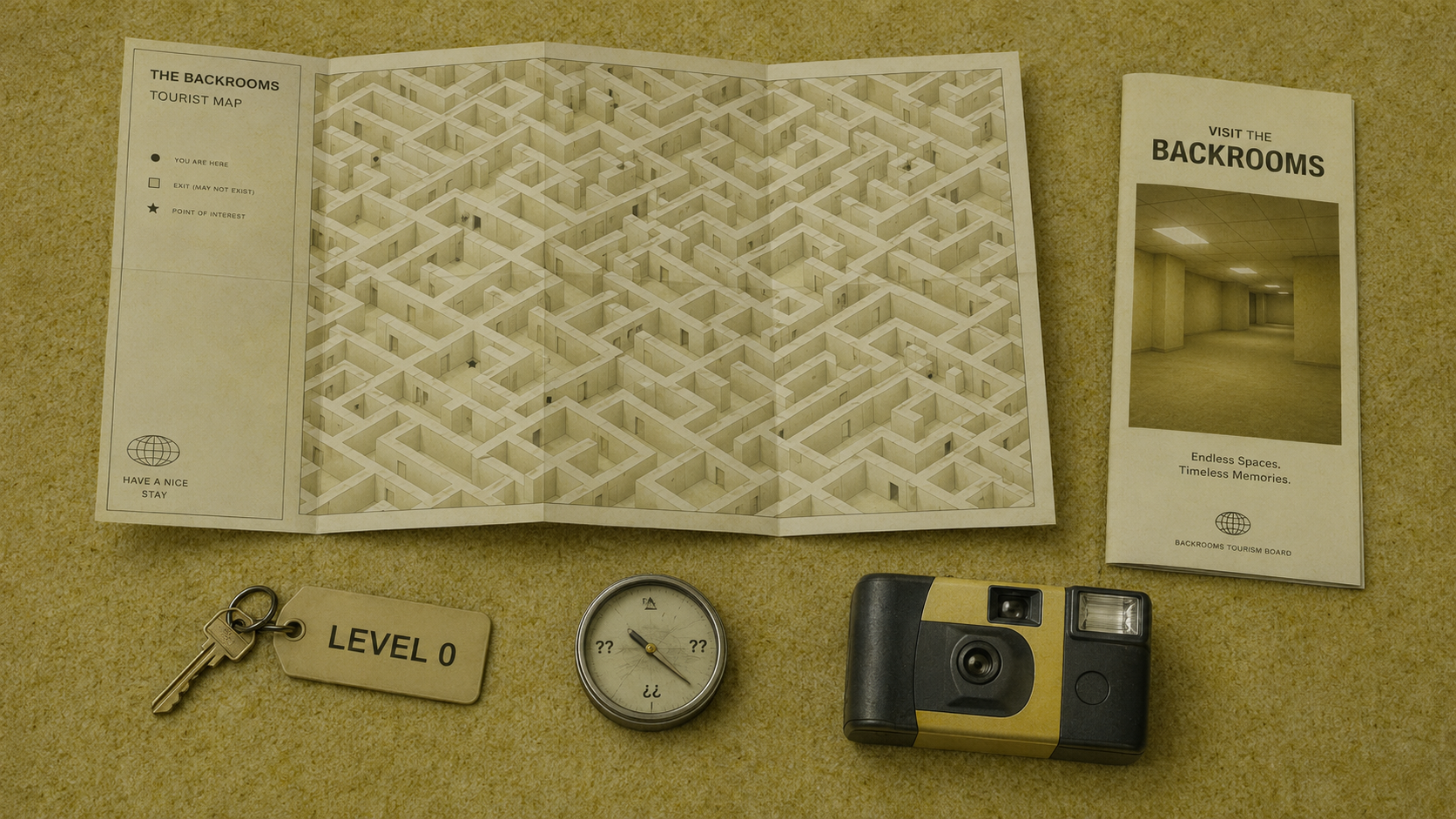
The Backrooms have no coordinates. You can't get there by plane, they require no ticket, and they appear on no map. And yet they are explored, described and expanded like a territory. Those who enter learn to recognise their spaces, consult maps, watch the accounts of people who claim to have already been there, and search for new passages toward still-unknown levels.
According to Sophie James and James Cronin, researchers at Lancaster University, these behaviours can be interpreted as a form of tourism. In their study, published in Annals of Tourism Research, they define the Backrooms as a case of «para-terrestrial dark tourism»: a journey toward a place that appears real enough to be visited, yet does not exist in physical geography.
The Backrooms were born in 2019 from a photograph posted anonymously on 4chan: empty rooms, yellow wallpaper, worn carpet and the constant hum of fluorescent lights. The internet transformed that image into a potentially infinite labyrinth. Stories, videos, fake documents and exploration diaries have added new environments, creatures and rules to a mythology that has no single author.
The researchers studied in particular the Reddit community dedicated to the Backrooms. Here users do not merely observe an invented world: they contribute to building it. A new map, a piece of footage or the account of an expedition can extend the shared territory and become material for subsequent explorations. The visitor is also cartographer, guide and author of the destination they are visiting.
This is the main difference from traditional tourism. A city, a museum or a battlefield pre-exists the tourist and is organised through routes, guides and official versions. The Backrooms, by contrast, exist only while they are being narrated. There is no authority to establish their definitive form and there is no original to preserve.
Their incompleteness is part of the attraction. The rooms are recognisable enough to give the impression of having already been walked through, yet undefined enough to always promise another corridor beyond the one already known. According to the study, this participatory construction at least partly replaces the organisation and commercialisation typical of real tourist destinations.
The Backrooms have by now left the more marginal corners of the internet. After being turned into videos, series and video games, in 2026 they arrived in cinemas with a film produced by A24 and directed by Kane Parsons, the creator of the YouTube series that had helped expand the legend.
But the most interesting transformation had already happened before the film. The internet did not merely serve to represent an imaginary place: it became the place itself. To go to the Backrooms you don't need to set off anywhere. You just have to enter a collective narrative and accept that a place can exist enough to be visited, without existing enough to be found.
Fonti: Sophie James e James Cronin, When dark tourism goes para-terrestrial: Online legend-tripping and touring the void, Annals of Tourism Research; Lancaster University; Associated Press.
