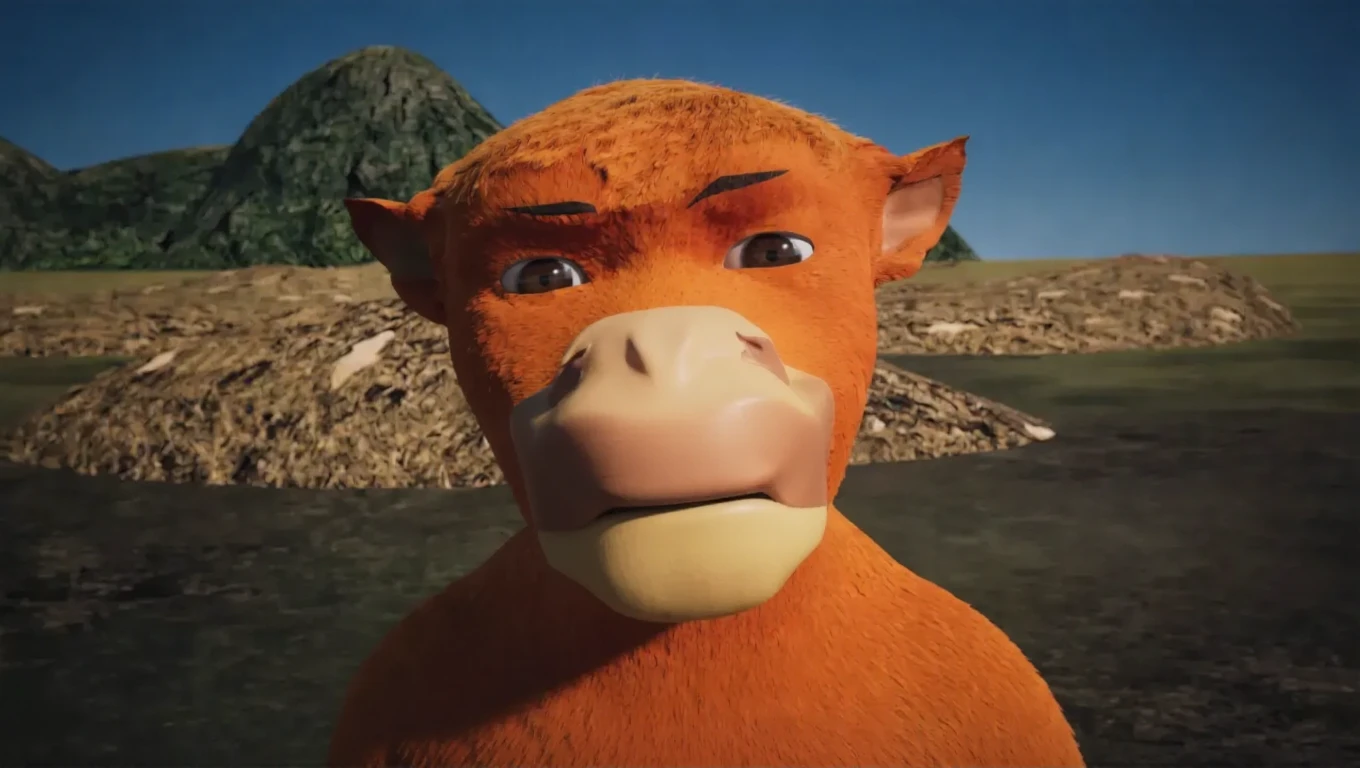
For the first ten days Niu Lai looked destined to disappear. The Chinese animated film, released on 5 August, had grossed just over seven thousand yuan in total, with days bringing in two hundred and halls where about ten people sat. The characters looked like they'd come out of 3D software from twenty years ago and the story was elementary: on Douban, the site where films are rated and reviewed in China, the first reviews began describing it as something worth watching precisely to understand how bad it could be.
Then came the worst humiliation you can inflict on a bad film: recommending it. As a joke.
«It's brilliant, you absolutely have to see it» became the way to get a friend to buy a ticket and let them discover for themselves what they'd paid for. A nineteen-year-old student from Shanghai told the Associated Press he'd sent two friends to the cinema exactly like that, and one of them fell asleep. On Douban, meanwhile, five-star reviews written for laughs were rolling in — «incredibly terrible and enlightening», «a must-see for stock market investors» — while the average rating didn't appear, because there weren't yet enough scores for the system to calculate it: the film's reputation formed entirely in the comments.
The circuit responded within a day: on 14 August there were fewer than five scheduled screenings, on 15 August more than thirteen hundred. On Monday 17 Niu Lai grossed 8.2 million yuan in a single day, with nearly three hundred thousand viewers, and the total surpassed 17 million. It had become a hit.
The curious thing is that the film had not been engineered to become a meme. According to Chinese media, director Xin Yumeng reportedly made it over five years together with his mother, Sun Lifang, splitting the screenplay, dubbing and production between them. The distributor, who has known him for a long time, said he had advised him not to release it in cinemas after seeing the final cut, and found himself up against his insistence.
The internet has long known hate-watching: we watch something because we want to tear it apart. Here the mechanism is slightly different, because audiences go to the cinema knowing that everyone knows that everyone thinks it's bad. The ticket buys admission to a collective joke. It's the same mechanism that turns an irritating song into a hit and a one-star review into an involuntary form of advertising: the more people insist that something is unwatchable, the more the curiosity to see for yourself grows.
How quickly things have changed can be measured against a Chinese precedent. In 2017 a film directed by Bi Zhifei received a score of 2 out of 10 on Douban, grossed less than a tenth of its stated budget and ended up in court: the director asked the film authority to investigate the platform, Douban sued him for defamation and his claims against the site were dismissed. Nine years ago a mass panning ended a film's commercial life. Today it sells tickets.
In the case of Niu Lai a second layer also appeared. Some viewers began to defend it for the very thing that had initially been seen as its problem: now that mediocre images churn out in series from sophisticated software and generative models, that wrong, out-of-proportion animation visibly looks handmade by someone. A teacher interviewed by the AP contrasted it with visually flawless films that still fail to engage. Incompetence works as a signature as long as everything else is smooth: today being unmistakably bad turns out to be more memorable than being quietly beautiful.
Inside the cinemas, though, the joke has a named target. A programming manager at one circuit, quoted by the Chinese press, summed up the week by saying that «the moral and the joke are fighting each other», and the Beijing News called on exhibitors to act as a filter. For decades marketing has tried to convince us that something was better than it really was; the internet has discovered that sometimes the opposite works too. The ones cashing in this time are two people who put five years into it: the director also did the dubbing, and the company that produced the film, until 2021, was renovating houses.