
Does the Gaza that exists in the feeds have anything in common with the real one? The strip of land on the eastern coast of the Mediterranean and the algorithmic Gaza share the same name. And yet, on one side there is a territory harassed, subjugated and exploited, struck by bombardments, food crises and a chronic shortage of essential goods. On the other there is a Gaza shaped by the digital collective mind: a constant presence in the trending topics, a point of convergence for many pre-existing online phenomena, from performative activism to fandoms, from call-outs to shitstorms. In this passage from geography to screen a territory is turned into content: a kind of alchemical process in which solidarity is sublimated into identity.
Online, Gaza is an ecosystem of videos and images, slogans, social practices with a shared ethical code of their own, symbols, emoji and a well-defined ritual, one that in many respects recalls the way fandoms and communities built around pop stars, cultural products or television series organize themselves. The point is that support for a population ends up becoming, as well, a tool for building personal and, above all, collective identity. In the real world, this identity dimension tied to Gaza can be found in certain university spaces and in social centers. Online, by contrast, it was above all pre-existing fandoms and communities that embraced the cause, at times interweaving with the networks of university activism already present on the platforms. The clearest expression of this convergence is the influencers who have made the Palestinian cause their own, but also figures who became influencers and content creators precisely by covering almost nothing but this topic. All of this happened extraordinarily fast: from October 7 to today. To analyze the gap between the real Gaza and the algorithmic Gaza means asking questions not only about war or solidarity, but about the way digital platforms turn events, territories and people into objects of participation, emotional investment and collective identification.

To understand how the algorithmic Gaza took shape, we have to go back to October 7, 2023. The Supernova Festival massacre unfolded as a kind of punishment “come down from the sky,” inside a gathering of young people from all over the world, united by a passion for techno and electronic music. The dissonance between their hippie looks and the violence of the attack helped to fix that traumatic collective event in the public imagination: the girls’ hair decorated with braids and ribbons, the colorful sarongs, the great Buddha statue that towered in the middle of the main stage. And then the DJ hiding behind the console, joy giving way to terror, surprise turning into horror, and finally the flight with no way out. The footage some ravers shot on their smartphones documented the moment when the festive atmosphere flipped into its opposite.
The spectacularization of violence is a hallmark of contemporary terrorism, which aims not only to cause death and fear but also to capture attention. To strike a concert means to act on an immediately recognizable symbol and to amplify the media impact of the attack, as had already happened at the Bataclan or in Manchester. In the case of the Supernova Festival, though, the quantity of images and footage available was unprecedented, turning the event into a global viral phenomenon. From that moment on the conflict developed not only on the military terrain but also inside the digital platforms. The trauma of October 7 polarized public debate, generating opposing readings of events and helping to redefine the perception of the Palestinian question. If for decades the Palestinian cause had remained mostly a political matter, often confined to certain militant circles, in the post-Covid digital ecosystem Gaza took on a different nature: from the theater of a conflict it also became an object of online participation, collective identity and permanent mobilization.
Unexpectedly, in some highly visible niches of online opinion, the victims of the Supernova Festival received very little compassion. Especially among young Westerners who did not identify with them, and who at times went so far as to despise them because they had gone dancing “next to a concentration camp,” that is, Gaza, or at least the Gaza they had in mind. The massacre was quickly reinterpreted as an “act of resistance,” and the human sacrifice, if not legitimized, was at any rate subordinated to a cause deemed more important. With the start of the Israeli bombardments, the situation deteriorated further online as well. This transformation can be clearly read through the tools of web listening: in the explosion of Google searches, mentions and discussions around terms like “Gaza,” “Palestine” and “genocide,” which after October 7 took on a new centrality, continuity and moral charge. From that moment on, the long Israeli-Palestinian conflict ceased to be merely a geopolitical event and became one of the main online battlefields, complete with clashes between communities and fandoms, call-outs and shitstorms used as offensive weapons.
The algorithm soon soaked up the colors of the Palestinian flag. Many feeds filled with videos and reels evoking war zones, posted by accounts that declared themselves located in Gaza. These were, in any case, contents marked by strong engagement and often accompanied in the bio by links to GoFundMe or PayPal for donations. Alongside these videos, more or less violent and dramatic, others emerged that were even more ambiguous: “aesthetic” shots with heaps of rubble and crumbled concrete in the background, set to emotional musical tracks. In other cases actual content creators were involved, using formats typical of social media such as ASMR, “a day in the life,” cooking and lifestyle videos, but set in Gaza. Meanwhile, celebrities and pop stars, widely followed influencers and TikTokers progressively signed on to the cause too, displaying pins and symbols; some sooner, some later, often under pressure or prompting from their respective communities. Anyone who did not take part, in fact, could be considered suspect and “complicit in the genocide,” and thus liable to call-outs and loss of followers.
It is as if many of the causes of the performative activism of the previous years, progressively weakened in their capacity to drive the trends (MeToo, BLM, environmentalism and transfeminism), had converged and reorganized themselves around Gaza. Even the fandoms of the pop stars, already accustomed to forms of performative activism, began to add the watermelon emoji to their bios on X and Instagram, which became to all effects one of the symbols of the pro-Pal movement online. In this process, what had once been a pro-Palestinian movement tied to parties, associations or traditions progressively turned into a community, or rather into a fandom of its own, with its own reference celebrities, influencers, popularizers and public figures. Among these, figures like Greta Thunberg, who moved from environmental activism to the pro-Pal cause, helped to consolidate this new configuration. Gaza thus ended up representing not one cause among others, but the cause through which to read all the others.
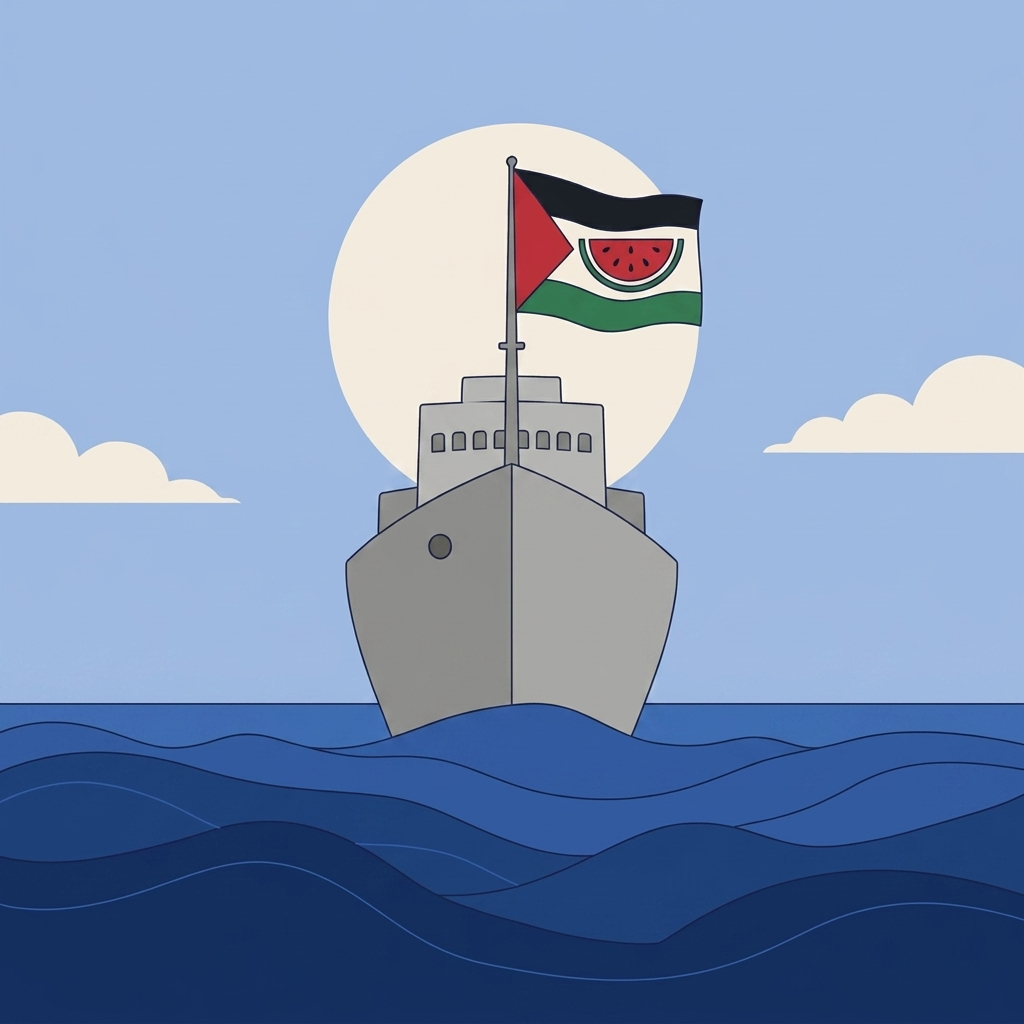
Since we are dealing with a trend, it is also possible to identify the main peaks of attention. The first is tied to the days immediately following October 7, 2023. The second, instead, is entirely traceable to a piece of digital content: the viral image generated with artificial intelligence and circulated in May 2024, which showed an expanse of tents arranged so as to form, seen from above, the words “All Eyes on Rafah.” The image spread rapidly thanks to the “Add Yours” feature of Instagram Stories, becoming one of the most viral contents of the pro-Pal mobilization (over 45 million shares). The third and, for now, latest great peak is associated with the voyage of the Global Sumud Flotilla in the autumn of 2025, which generated an enormous emotional wave on social media. In this case too, the participation of influencers, creators and public figures hugely amplified the reach of the event, through videos, appeals and firsthand testimonies addressed to their respective communities. The Flotilla never reached Gaza: it was intercepted by Israel before reaching the Strip. And yet, in many respects, its meaning seems to have been more important than its actual destination. In this sense, it recalls the expeditions in search of lost places, like Atlantis and Agartha, inhabited by civilizations held to be “pure” and “intact.” Gaza, by contrast, must be freed from those who hold it captive, the place where a form of original moral purity, felt to be lost in Western societies, can be found again.
The impression is that a part of online activism has progressively replaced its relationship with the material reality of the war with an ecosystem of viral content, automatic reposts, aesthetics of suffering and digital rituals of collective atonement. The majority of people will never see Gaza, do not know any Palestinians, do not understand the historical context, would not be able to place many of the events they discuss daily; and yet they feel they have an intimate, moral relationship with Gaza. It is, then, a relationship that shifts onto a plane that is ever less political and ever more spiritual. In certain respects, even esoteric: when a faraway place inwardly organizes the consciousness of millions of people, it ends up being evoked more than known. Gaza ceases to be merely a territory and becomes a mirage, a “promised land.” From this perspective, “performative Palestine,” or algorithmic Gaza, can be read as a form of collective digital hallucination, spread through platforms: an aspirational place onto which a part of the progressive West projects guilt, a longing for purity, a need for moral belonging and a search for meaning.

